A historic district where character is the asset.
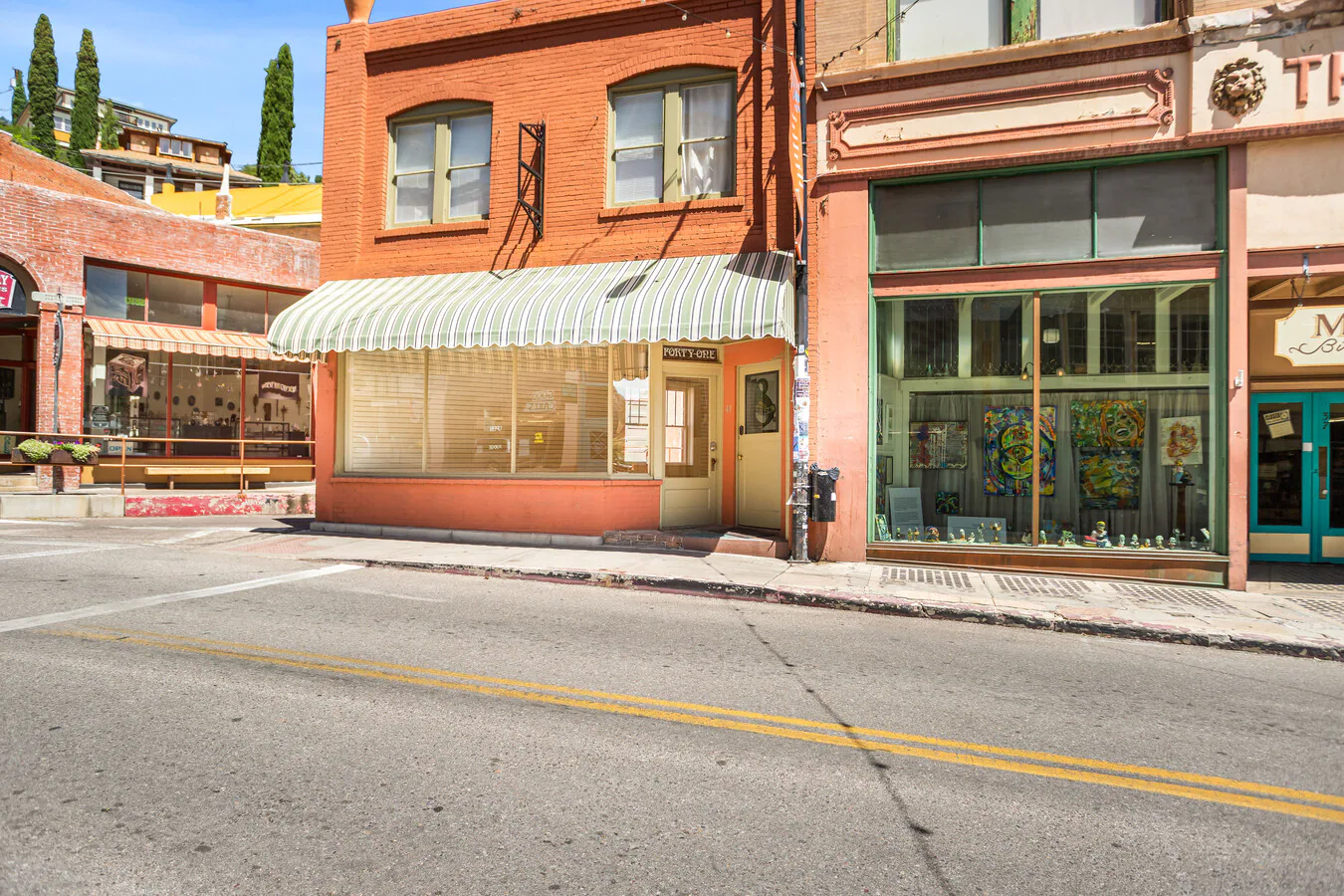
Few American downtowns arrive with this combination of age, scale, and architectural condition. Bisbee's Main Street corridor is a working artifact of the early-twentieth-century West, built to the ambitions of a city that briefly rivaled Tucson.
The city was founded in 1880 after prospectors followed copper deposits into the Mule Mountains. Within a generation, the Phelps Dodge Corporation had transformed a mining camp into a regional capital. By 1910, Bisbee was among the largest cities in the Arizona Territory, with a population that reached 25,000 at its peak. Its commercial district along Main Street reflected that confidence: Romanesque and Mission Revival storefronts, multi-story mixed-use blocks, and civic institutions built in brick and stone intended for permanence. The copper that came out of the surrounding hills funded one of the most ambitious commercial streetscapes in the territorial Southwest.
Production slowed through the mid-twentieth century. When Phelps Dodge closed its underground operations in 1975, the city faced a crossroads common to former boomtowns. What followed was unusual. Rather than large-scale demolition or suburban expansion, Bisbee contracted quietly. Artists, photographers, and craftspeople arrived through the late 1970s and 1980s, drawn by low rents and a built environment that larger cities had long since cleared. The architecture that mining wealth built survived intact, not because of formal preservation campaigns, but because rapid growth simply stopped. The result is a downtown that reads as it was designed: dense, human-scaled, and genuinely irreplaceable.
A Demographic Shift Already Underway
Remote work has untethered a generation of buyers and tenants from metropolitan anchors. Bisbee appears consistently on national shortlists of distinctive small cities prized precisely because they cannot be replicated. The combination of walkable Main Street retail, gallery and hospitality demand, proximity to Tucson, and the stable employment base anchored by Fort Huachuca creates a demand profile that continues to grow. Comparable arts-economy historic towns across the West have seen sustained appreciation as lifestyle-driven relocation accelerates. Bisbee is positioned at the front of that wave, not behind it.
Supply That Cannot Grow
The canyon topography that shaped Bisbee's original layout continues to constrain new development. Historic district designations add a regulatory layer that effectively eliminates new infill on Main Street. Short-term rental demand from tourism and cross-border travelers has added a third income lever for mixed-use owners alongside retail and long-term residential. The buildings available today represent a genuinely finite set. When supply is structurally constrained and demand is growing from multiple directions, the arithmetic of long-term ownership becomes straightforward.
Finite Inventory
Downtown sits within a National Register Historic District. The canyon geography and preservation rules mean the supply of genuine Main Street commercial buildings is fixed. They are rarely sold and cannot be built again.
Resilient Demand
Year-round visitors, a growing creative community, proximity to Fort Huachuca, and rising short-term rental demand give Bisbee property owners multiple revenue channels not available in comparable small-town markets.
Mixed-Use by Right
Storefront-below, residence-above floor plans let owners pair commercial rental income with flexible upper-level use under established downtown zoning, without requiring variances or entitlement risk.
.jpg)